
Learn the three phases of Oracle ASM rebalancing – planning, extent relocation, and disk compacting. Understand how ASM redistributes data efficiently with minimal downtime.
Introduction
Oracle Automatic Storage Management (ASM) provides high availability and optimal I/O performance by automatically managing disk storage.
Whenever disks are added, dropped, or resized, ASM triggers a rebalance operation to evenly distribute data across the disk group.
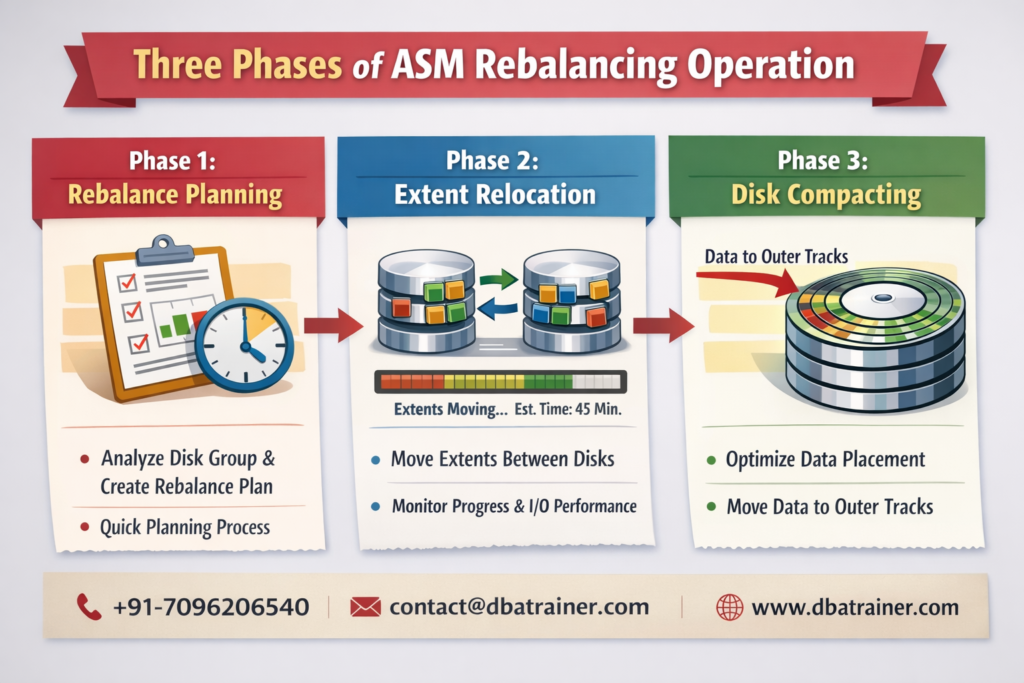
ASM rebalance is internally executed in three well-defined phases, ensuring efficiency and performance stability.
Phase 1: Rebalance Planning
In this initial phase, ASM analyzes the disk group and prepares a rebalance strategy.
Key activities include:
-
- Identifying the rebalance trigger (ADD / DROP / RESIZE disk)
-
- Analyzing disk group size and number of files
-
- Determining which extents need redistribution
 This phase is lightweight and usually completes within a few minutes.
Phase 2 : Extent Relocation
This is the most time-consuming phase of the ASM rebalance process.
What happens here:
-
- ASM moves data extents between disks to achieve uniform distribution
-
- I/O load is dynamically managed based on system performance
-
- Progress is continuously tracked
DBAs can monitor the estimated completion time using:
SELECT * FROM GV$ASM_OPERATION;
This view provides EST_MINUTES, which is calculated dynamically based on I/O throughput and extent movement speed.
Phase 3 : Disk Compacting
Introduced in Oracle ASM 11.1.0.7 and later, this phase optimizes data placement.
Purpose of disk compacting:
-
- Moves data closer to the outer tracks of disks
-
- Improves I/O performance
-
- Optimizes disk layout after rebalance completion
This phase fine-tunes the disk group for long-term performance benefits.
Conclusion
The three-phase ASM rebalance mechanism ensures:
-
- Efficient data redistribution
-
- Minimal impact on database availability
-
- Optimized disk performance
Understanding these phases helps DBAs plan maintenance activities and monitor rebalance operations effectively.