
Exadata Smart Flash Log is designed to eliminate redo logging bottlenecks by accelerating performance-critical redo write operations in Oracle Exadata environments.
In high-performance OLTP systems, transaction commit time is directly dependent on redo log write latency. Even small spikes in redo write latency can significantly impact response times and overall database throughput.
What is Exadata Smart Flash Log?
Exadata Smart Flash Log is a feature of Oracle Exadata that improves transaction response times by reducing redo log write latency using flash storage.
Redo writes are extremely latency-sensitive because:
- A transaction commit waits for redo persistence
- Space management operations depend on redo
- Index splits are sensitive to redo latency
- High commit workloads amplify small latency spikes
Even though disk controllers use battery-backed DRAM cache, redo writes can still experience latency spikes when:
- Controller cache becomes saturated
- Disk throughput limits are reached
- Write queues grow during peak workloads
Even a few slow redo writes can create noticeable performance degradation.
How Exadata Smart Flash Log Works (Pre-20.1 Behavior)
Before Oracle Exadata System Software 20.1, Exadata Smart Flash Log works as follows:
- LGWR issues a redo write
- The redo block is written simultaneously to:
- Disk
- Flash storage
- The write is acknowledged when the first write completes
- The slower device completes in the background
Result:
- Reduced average redo write latency
- Elimination of latency spikes
- Improved transaction response time
- Higher overall database throughput
However, because redo must eventually persist to disk, overall logging throughput remained constrained by disk bandwidth.
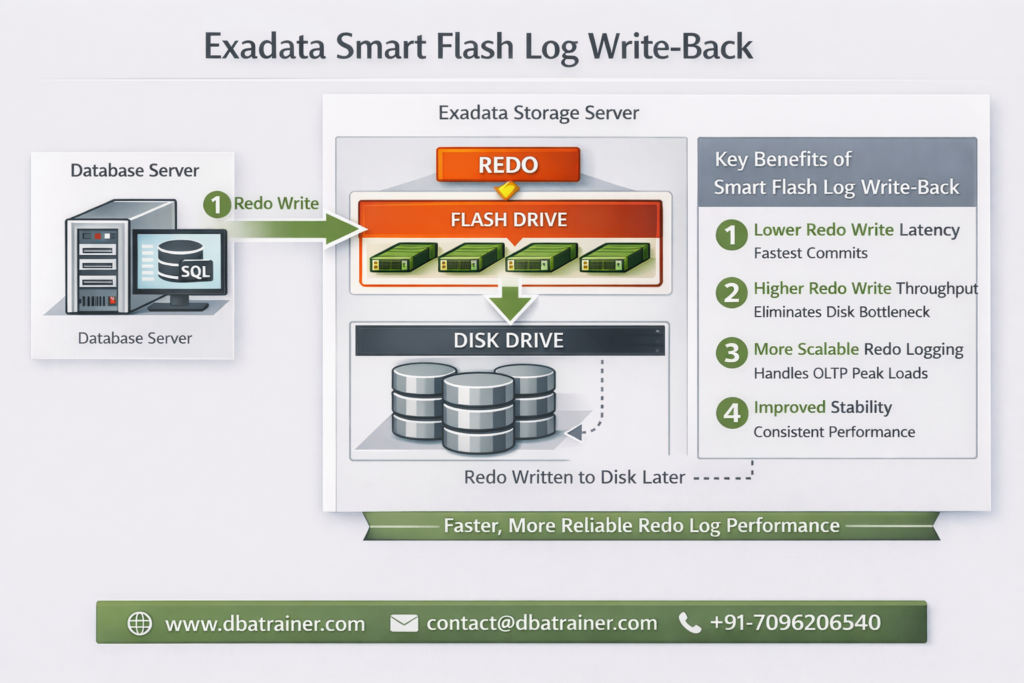
Smart Flash Log Write-Back (Introduced in 20.1)
Starting with Oracle Exadata System Software 20.1, a major enhancement was introduced:
Smart Flash Log Write-Back
Instead of writing redo simultaneously to disk and flash, redo is written to:
- Exadata Smart Flash Cache (in Write-Back mode)
This removes disk as a bottleneck for redo logging.
Benefits of Smart Flash Log Write-Back:
- Lower average redo latency
- Higher redo throughput
- Elimination of disk logging bottlenecks
- Improved scalability for high-commit systems
This enhancement is particularly beneficial for:
- Financial transaction systems
- High-frequency OLTP workloads
- Large batch systems with heavy logging
- Throughput-intensive applications
Why Exadata Smart Flash Log Is Important
1️⃣ Reduces log file sync Waits
Commit response time improves immediately.
2️⃣ Eliminates Latency Spikes
Parallel media writes prevent single-device delays from affecting commits.
3️⃣ Increases Database Throughput
Higher redo throughput allows more transactions per second.
4️⃣ Improves Stability Under Load
Performance remains consistent during peak I/O activity.
Exadata Smart Flash Log vs Write-Back Flash Cache
| Feature | Exadata Smart Flash Log | Write-Back Flash Cache |
| Applies To | Redo logs | Data files |
| Improves | Commit latency | Data block write latency |
| Wait Event Reduced | log file sync | db file parallel write |
| Write Pattern | Sequential | Random |
| 20.1 Enhancement | Write-Back mode | Already supported |
| Use Case | High commit OLTP | Write-intensive workloads |
These features are complementary — not replacements.
When Should You Investigate Exadata Smart Flash Log?
Look at this feature if you observe:
-
High
log file syncwaits -
High redo write latency
-
Commit bottlenecks
-
Disk-bound redo throughput
If redo is your bottleneck, Exadata Smart Flash Log is the solution.
Final Thoughts
Exadata Smart Flash Log is one of the most impactful performance optimizations available in Oracle Exadata for transaction-heavy environments.
By reducing redo latency and eliminating logging bottlenecks, it:
- Improves transaction response time
- Increases database throughput
- Stabilizes performance under peak load
- Enables better scalability
With the introduction of Smart Flash Log Write-Back in Exadata System Software 20.1, redo logging can now fully leverage flash performance — removing traditional disk limitations.