
How Persistent Memory and RDMA Redefined Database I/O Performance
Modern Oracle Exadata systems introduced a major shift in database I/O architecture with the use of Persistent Memory (PMEM) and Remote Direct Memory Access (RDMA).
Together, these technologies significantly reduced I/O latency, CPU overhead, and data movement between storage and database servers.
This blog explains what PMEM and RDMA are, why they were introduced, and how they work together in Exadata.
Why traditional storage was no longer enough..?
Before Exadata X8M, even with NVMe flash, database I/O followed this path:
Storage → OS Kernel → TCP/IP → CPU → Database
This introduced:
-
- Multiple memory copies
-
- Kernel context switches
-
- High CPU usage
-
- Network stack latency
As databases became:
-
- More latency-sensitive (OLTP)
-
- Highly concurrent
-
- Mixed with analytics
Flash alone could not deliver consistent microsecond performance.
This led Oracle to introduce PMEM for speed and RDMA for transport.
What is PMEM (Persistent Memory)?
Persistent Memory (PMEM) is a storage-class memory technology that combines the speed of memory with the persistence of storage.
Key characteristics of PMEM
-
- Non-volatile (data survives power loss)
-
- Much faster than NVMe flash
-
- Slower than DRAM, but close
-
- Byte-addressable
In Exadata, PMEM is installed inside storage servers and is managed entirely by Exadata software.
How PMEM is used in Exadata.?
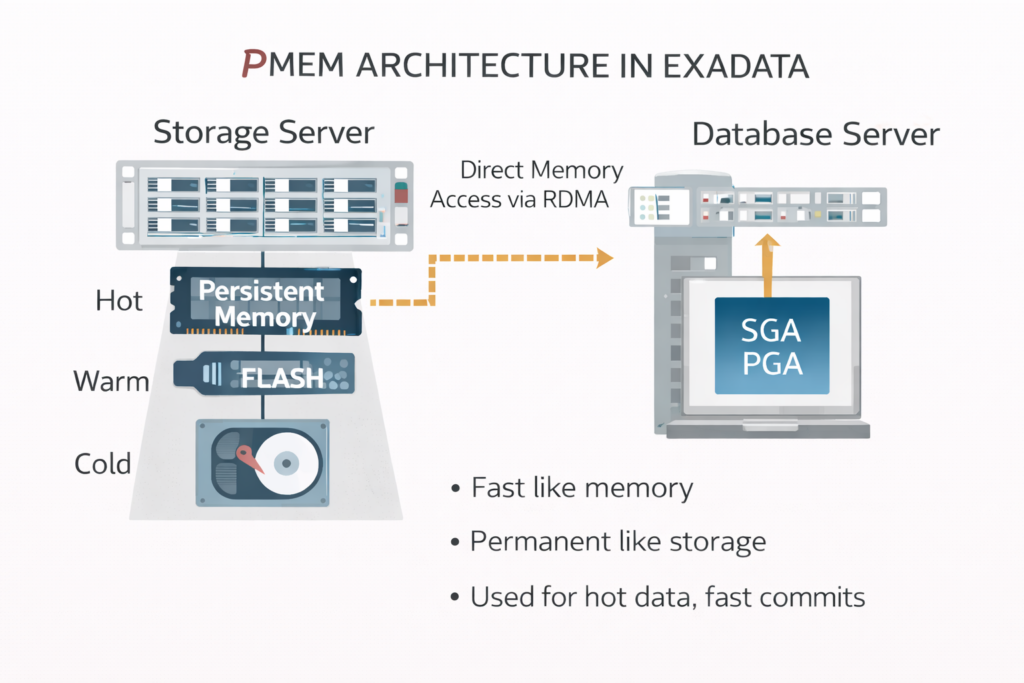
PMEM acts as a new tier in the storage hierarchy:
| Data Temperature | Storage Tier |
| Hot | PMEM |
| Warm | NVMe Flash |
| Cold | Disk |
PMEM use cases in Exadata
-
- Caching frequently accessed data blocks
-
- Accelerating Smart Scan reads
-
- Speeding up redo log commits
PMEM allows Exadata to keep hot data extremely close to the database, without sacrificing durability.
What is RDMA (Remote Direct Memory Access)?
-
- Operating system kernel
-
- TCP/IP stack
-
- Remote CPU involvement
Exadata uses RoCE (RDMA over Converged Ethernet).
Key benefits of RDMA
-
- Microsecond-level latency
-
- Zero-copy data transfers
-
- Very low CPU usage
-
- Predictable performance under load
RDMA is not storage or memory—it is the transport mechanism.
Traditional I/O vs RDMA-based I/O
Traditional TCP/IP I/O
Storage → Kernel → CPU → Network → CPU → Kernel → Database
RDMA-based I/O
Storage Memory → Database Memory (Direct)
RDMA removes multiple layers from the data path, making memory access across servers almost as fast as local access.
How PMEM and RDMA work together in Exadata
PMEM and RDMA solve different problems, but complement each other perfectly.
-
- PMEM provides a fast, persistent place to store data
-
- RDMA provides the fastest possible way to move that data
Simplified architecture
PMEM (Storage Server)
↓ RDMA
Database Server Memory
With this design:
-
- Data is read directly from PMEM
-
- RDMA transfers it without CPU or kernel overhead
-
- Latency drops to microseconds
PMEM + RDMA for read operations
For large scans and analytics:
-
- Data resides in PMEM
-
- Database server requests data
-
- RDMA transfers data directly from PMEM
-
- Only relevant rows and columns are returned
This dramatically reduces:
-
- I/O volume
-
- Database CPU usage
-
- Query response time
PMEM + RDMA for write operations (commits)
For commit-heavy OLTP workloads:
-
- Redo is written to PMEM (non-volatile)
-
- Commit is acknowledged immediately
-
- Data is later flushed to flash or disk asynchronously
This results in:
-
- Faster commits
-
- Lower log file sync waits
-
- No loss of durability
Why PMEM + RDMA was a breakthrough
Together, PMEM and RDMA delivered:
-
- Up to 10x lower latency
-
- Higher throughput
-
- Better RAC scalability
-
- More predictable performance
Most importantly:
Performance gains came without application or schema changes.
PMEM and RDMA scope in Exadata
-
- PMEM is available in:
-
- Exadata X8M
-
- Exadata X9M
-
- PMEM is available in:
-
- RDMA remains a core transport technology in Exadata
-
- Both are fully integrated and automatically managed
DBAs do not need to:
-
- Tune applications
-
- Modify SQL
-
- Manage memory tiers manually
Simple analogy
-
- PMEM → A high-speed, persistent warehouse
-
- RDMA → A frictionless express highway
-
- Database server → The consumer of data
The faster the warehouse and highway, the faster the business runs.
One-line summary
PMEM provides fast, persistent storage close to the database, and RDMA deliver it with minimal latency and CPU overhead.
Final takeaway
PMEM and RDMA together marked a fundamental redesign of database I/O in Oracle Exadata.
Instead of pushing more data through traditional storage stacks, Exadata brought data:
-
- Closer to the database
-
- Faster than flash
-
- With minimal overhead
This architecture laid the foundation for everything that followed in modern Exadata systems.