
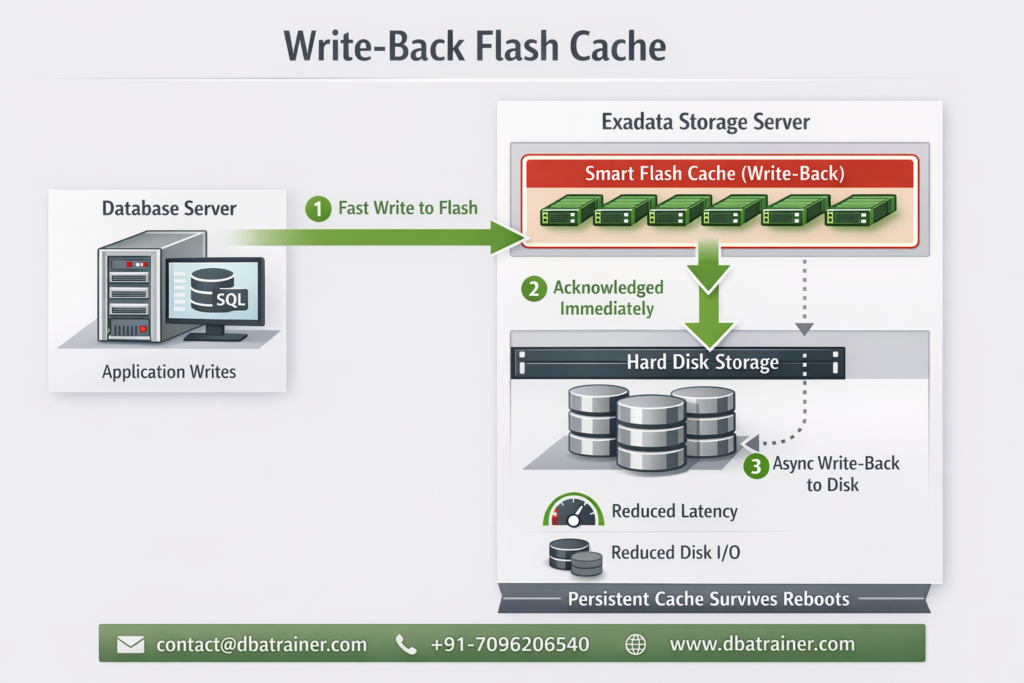
Write Back Flash Cache in Oracle Exadata is a performance optimization feature that allows database write operations to be temporarily stored on flash storage before being written to disk, significantly improving write latency and throughput.
Modern enterprise databases demand low latency, high throughput, and predictable performance, especially for write-heavy workloads. To address this, Oracle Exadata introduced a powerful optimization known as Write-Back Flash Cache, enabling database writes to be absorbed directly by flash storage instead of slow spinning disks.
Let’s break down what Write-Back Flash Cache is, why it matters, and when you should use it.
Write-Back Flash Cache in Oracle Exadata
Write-Back Flash Cache allows database write I/Os to be written first to Exadata Smart Flash Cache and later flushed to disk asynchronously.
This capability was introduced with Oracle Exadata System Software release 11.2.3.2.0 and marked a major shift from traditional write-through behavior.
Traditional Write-Through (Before)
-
- Writes go directly to disk
-
- Flash is mainly used for reads
-
- Higher latency for write-intensive workloads
Write-Back Mode
-
- Writes land in flash first
-
- Disk writes happen later in the background
-
- Applications see much faster write response times
Why Write-Back Flash Cache Matters
1. Ultra-Low Write Latency
Flash devices offer microsecond-level latency, far outperforming spinning disks. By absorbing writes in flash:
-
- Commit times drop
-
- I/O wait events reduce
-
- Overall database responsiveness improves
This is especially beneficial when you see:
-
- High I/O latency
-
- Frequent free buffer waits
-
- Write bottlenecks during peak workloads
2. Ideal for Write-Intensive Applications
Workloads that benefit the most include:
-
- OLTP systems
-
- Financial transaction platforms
-
- Batch processing with frequent updates
-
- Index-heavy applications
If your application writes aggressively, Write-Back Flash Cache can deliver immediate performance gains without application changes.
3. Reduced Disk I/O and Better Bandwidth Utilization
One of the hidden superpowers of Write-Back mode is I/O coalescing.
-
- Multiple writes to the same block are absorbed in flash
-
- Only the final version is written to disk
-
- Disk I/O volume is significantly reduced
This saved disk bandwidth can then be used to:
-
- Increase application throughput
-
- Support additional workloads
-
- Improve system scalability
Persistence Across Reboots — No Cache Warm-Up
Unlike traditional caches, Write-Back Flash Cache is persistent.
-
- Cache contents survive storage server reboots
-
- No warm-up period is required
-
- Performance remains consistent after restarts
This is a huge operational advantage in mission-critical environments.
Data Protection Considerations
Write-Back mode introduces an important responsibility.
What Happens If Flash Fails?
If a flash device fails before dirty data is written to disk, that data must be recovered from a mirror copy.
Oracle’s Recommendation
To safely use Write-Back Flash Cache:
-
- Enable High Redundancy (Triple Mirroring)
-
- Ensure database files are protected against flash failure
This makes Write-Back mode enterprise-safe while preserving performance benefits.
When Should You Enable Write-Back Flash Cache?
You should strongly consider it if:
-
- Your workload is write-heavy
-
- You experience high write latency
-
- Disk I/O is a performance bottleneck
-
- You are using high redundancy for storage
You may avoid it if:
-
- Your workload is mostly read-only
-
- You cannot tolerate any dependency on flash redundancy
-
- You are using low redundancy configurations
Final Thoughts
Write-Back Flash Cache transforms Exadata into a write-optimized platform, delivering faster commits, reduced disk I/O, and higher throughput—all without application changes.
When combined with proper redundancy, it offers the best of both worlds: Flash-level performance
 Enterprise-grade reliability
For serious database workloads on Exadata, Write-Back Flash Cache is not just an optimization—it’s a competitive advantage.
| Feature | Write-Through | Write-Back |
| Write Path | Disk first | Flash first |
| Latency | Higher | Very low |
| Disk I/O | High | Reduced |
| Performance | Moderate | Excellent |
| Risk | Minimal | Needs redundancy |
Write-Back Flash Cache accelerates data file writes, not redo logs. Redo logs always bypass flash cache and write directly to disk for durability.
What is Exadata Smart Flash Log?
Exadata Smart Flash Log is a feature that accelerates redo log writes by using flash as a low-latency write destination, while still guaranteeing full redo durability.
In short:
Smart Flash Log = fast redo commits
Write-Back Flash Cache = fast data block writes
We will discuss more about Exadata Smart Flash Log in Next Blog…!!!!