
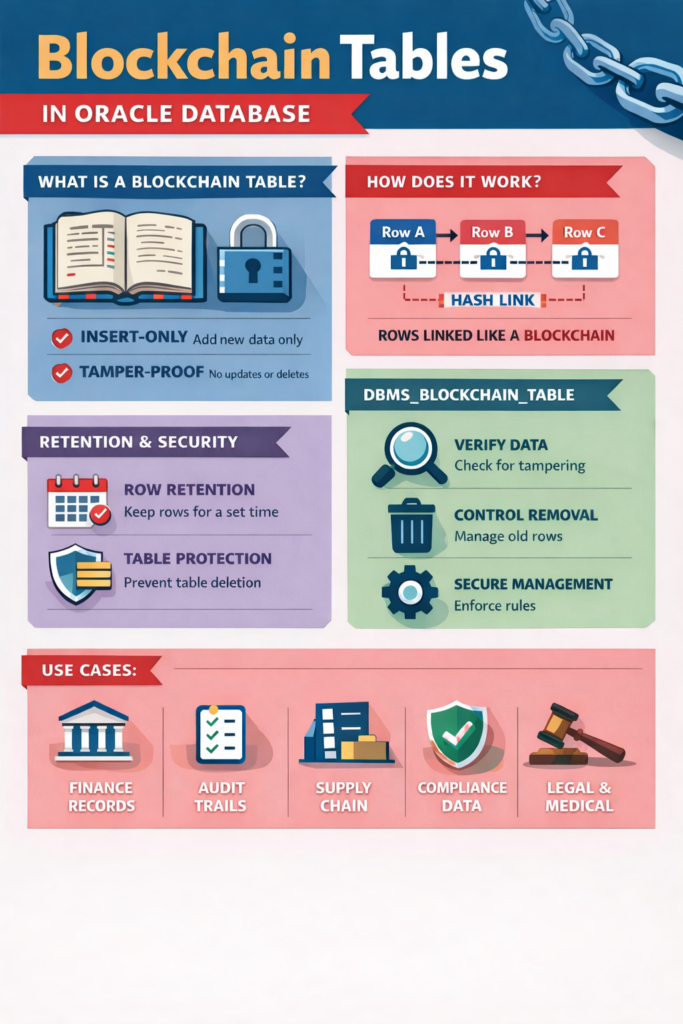
Oracle Database introduced a powerful feature called Blockchain Tables. This feature helps store data in a secure, tamper-proof, and trustworthy way, directly inside the Oracle Database.
 What Is a Blockchain Table?
A Blockchain Table is a special type of Oracle table where:
-
- You can only insert new data
-
- Existing data cannot be updated or deleted
-
- Data becomes permanent and tamper-proof
Once data is written, it stays exactly the same – forever or for a defined period.
 Why Did Oracle Introduce Blockchain Tables?
In many systems, data trust is critical.
Examples:
-
- Financial transactions
-
- Audit logs
-
- Compliance records
-
- Medical or legal records
Traditional tables allow:
-
- UPDATE
-
- DELETE
-
- TRUNCATE
This means data can be changed or manipulated.
 Blockchain tables solve this problem by enforcing immutability at the database level.
 How Blockchain Tables Work (Step by Step)
Let’s understand this in a simple way:
Step 1: Insert-Only Design
-
- Oracle allows only INSERT operations
-
- UPDATE and DELETE are blocked by design
Step 2: Row Chaining (Like a Blockchain)
-
- Each row is linked to the previous row
-
- Oracle calculates a cryptographic hash for every row
-
- That hash includes:
-
- The row’s data
-
- The hash of the previous row
-
- That hash includes:
 This creates a chain of rows
Step 3: Tamper Detection
If someone tries to change old data:
-
- The hash chain breaks
-
- Oracle immediately detects the tampering
 This guarantees data integrity and trust
 Retention Policies (Very Important Concept)
Blockchain tables use retention rules to control how long data is protected.
Row Retention
-
- Defines how long each row must stay unchanged
-
- Rows cannot be deleted before this period ends
-
- Can be:
-
- Permanent
-
- Time-based (example: 30 days, 1 year, etc.)
-
- Can be:
 Table Retention
-
- Protects the entire table
-
- Prevents accidental or unauthorized table drop
-
- Table can only be dropped under strict conditions
 These rules ensure long-term protection of important data
 What You Cannot Do with Blockchain Tables
Because they are designed for trust and security:
 You cannot update rows You cannot delete rows You cannot truncate the table You cannot drop the table easily You cannot modify table structure freely
 These limitations are intentional, not drawbacks
 What Is
 DBMS_BLOCKCHAIN_TABLE?
DBMS_BLOCKCHAIN_TABLE is a special Oracle-supplied package that helps you manage blockchain tables safely.
Since blockchain tables are highly restricted, Oracle does not allow normal operations for many tasks.
Instead, Oracle provides this package to handle controlled and secure management.
 What Does
 DBMS_BLOCKCHAIN_TABLE Do?
This package allows administrators to:
Verify Blockchain Integrity
-
- Checks whether the blockchain table data has been tampered with
-
- Validates the hash chain from start to end
Control Row Deletion (After Retention)
-
- Rows cannot be deleted manually
-
- After the retention period expires, Oracle can remove eligible rows
-
- This happens only through approved mechanisms
Secure Lifecycle Management
-
- Ensures blockchain rules are enforced
-
- Prevents misuse or bypassing of protection
In simple words:
DBMS_BLOCKCHAIN_TABLE is the official and safe way Oracle allows interaction with blockchain tables — without breaking trust.
 Real-World Use Cases
Blockchain tables are ideal for:
- Financial transaction logs
- Audit trail
- Supply chain records
- Compliance data
- Security logs
- Legal or medical records
Anywhere data trust matters, blockchain tables shine.
 Key Takeaways
Blockchain tables are insert-only Data is immutable and tamper-proof Oracle uses hash chaining internally Retention rules protect rows and tables DBMS_BLOCKCHAIN_TABLE ensures secure management and verification