Oracle AI Database 26ai Vector Search
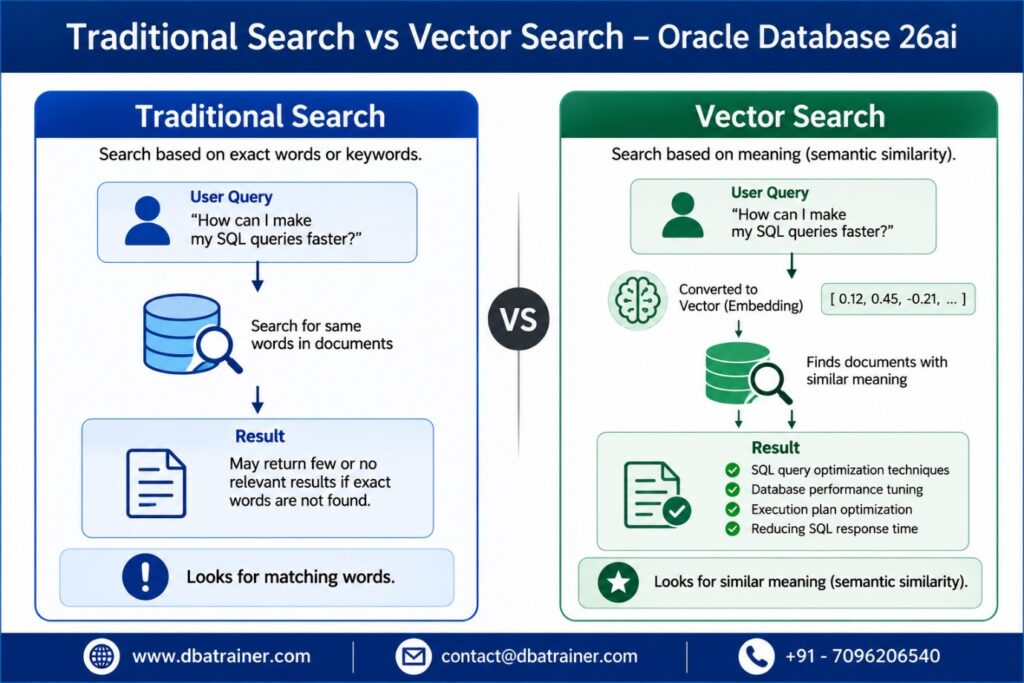
From Traditional Search to Semantic Search,Embeddings and Vectors Artificial Intelligence is changing the way applications search and understand information.Traditionally, databases search information using exact values, keywords, filters, and conditions. This works very well when we know exactly what we are looking for. But what if we want to search based on the meaning of the information rather than just matching words? This is where Vector Search comes into the picture. Oracle AI Database 26ai provides native AI Vector Search, which allows applications to search information based on semantic similarity. 1. What is Traditional Search? Let’s start with something familiar. Suppose we have an employee table and want to find employees from the IT department. We can simply run: SELECT * FROM employees WHERE department = ‘IT’; Here, the database checks the value of the department column and returns rows where the value is IT. We can also search text. For example: SELECT * FROM documents WHERE document_text LIKE ‘%performance%’; Here, the database is looking for the word performance. This is essentially keyword-based search. The database is asking: “Does this data contain the word or value that I am searching for?” This approach works very well for many traditional database applications. But there is a limitation. 2. The Problem with Keyword Search? Imagine that a user asks: “How can I make my SQL queries faster?” Now suppose we have a document containing: “SQL query optimization techniques can reduce execution time and improve database performance.” A human immediately understands that this document is relevant to the user’s question. But notice that the words are different. The user said: “Make SQL queries faster” The document says: “SQL query optimization” Both have a similar meaning. A traditional keyword search may not understand this relationship effectively because it primarily looks for matching words. Consider a few more examples: User Query Document Make SQL queries faster SQL query optimization Database is slow Database performance tuning Improve query response time Execution plan optimization Humans understand that these statements are related. But how can a computer understand the relationship? This is where Semantic Search comes in. 3. What is Semantic Search? Semantic search means searching based on the meaning or context of information rather than only looking for exact keywords.For example, suppose a user searches: “Find information about making SQL queries faster.” A semantic search system could identify documents related to: SQL performance tuning Query optimization Execution plan optimization SQL response-time improvement Database performance Notice that the exact words don’t necessarily have to be the same. The system is trying to identify information that has a similar meaning. This is the fundamental idea behind Vector Search. 4. How Does a Computer Understand Meaning? Now comes an important question. How can a computer understand that: “Make SQL queries faster” and “SQL query optimization” are related? This is where AI models come into the picture. An AI model called an embedding model can convert text into a numerical representation called an embedding. For example: Text: Oracle database performance tuning can be converted into something conceptually similar to: [0.21, -0.34, 0.87, 0.12, …] Another sentence: SQL query optimization could be represented by another set of numbers. These numbers are not simply keywords. Together, they represent characteristics of the information that allow AI systems to compare different pieces of data mathematically. Depending on the embedding model, a vector can contain hundreds or even thousands of numbers. 5. What is an Embedding? An embedding is a numerical representation of information. In simple terms: Text → Embedding Model → Vector For example: Oracle RAC performance ↓ Embedding Model ↓ [0.12, 0.45, -0.21, 0.87, …] The embedding model converts the original information into a form that a computer can mathematically compare. Embeddings can be generated for different types of information, including: Text Documents Images Other unstructured data The important concept to remember is: An embedding converts information into numbers so that similarity can be calculated. 6. What is a Vector? Now we can understand the term Vector. In simple terms: A vector is an ordered collection of numbers. For example: [0.12, 0.45, 0.87, 0.23] This vector contains four numbers, so we can say it has four dimensions. Another vector might look like: [0.10, 0.42, 0.90, 0.21] These two vectors are mathematically close to each other. When vectors represent text or other information, being close can indicate that the underlying information is semantically similar. This is the basic foundation of Vector Search. A simple way to remember it is: Text is converted into an embedding, and the embedding is represented as a vector. 7. A Simple Real-world Example Let’s take a simple shopping example. Imagine an online shopping application with these products: Running Shoes Formal Leather Shoes Sports Sneakers Office Chair Cricket Bat Now the customer searches: “Shoes for jogging” A traditional keyword search might look for the words: Shoes Jogging But a Vector Search system can convert the search query into a vector and compare it with vectors representing the products. The results could look conceptually like: Running Shoes → Very Similar Sports Sneakers → Similar Formal Leather Shoes → Less Similar Office Chair → Not Similar Cricket Bat → Not Similar The important point is that the system is not simply checking whether the exact words exist. It is trying to identify similar meaning. 8. How Does Oracle AI Database 26 ai Fit in? Now let’s bring Oracle into the picture. Oracle AI Database 26ai provides native capabilities for storing and searching vector data within the database. A simplified architecture looks like this: Source Data ↓ Documents / Text / Data ↓ Embedding Model ↓ Vector ↓ Oracle AI Database 26ai Business Data Documents VECTOR Data ↓ Similarity Search This means the vector representation of information can be stored and searched inside Oracle Database alongside traditional business data. For organizations already using Oracle Database, this can be very interesting because AI search capabilities can be integrated with existing database data and applications. 9. What is Oracle 26ai VECTOR Data Type One of the
Oracle AI Database 26ai Vector Search Read More »