RAC

Oracle ASM rebalancing phases

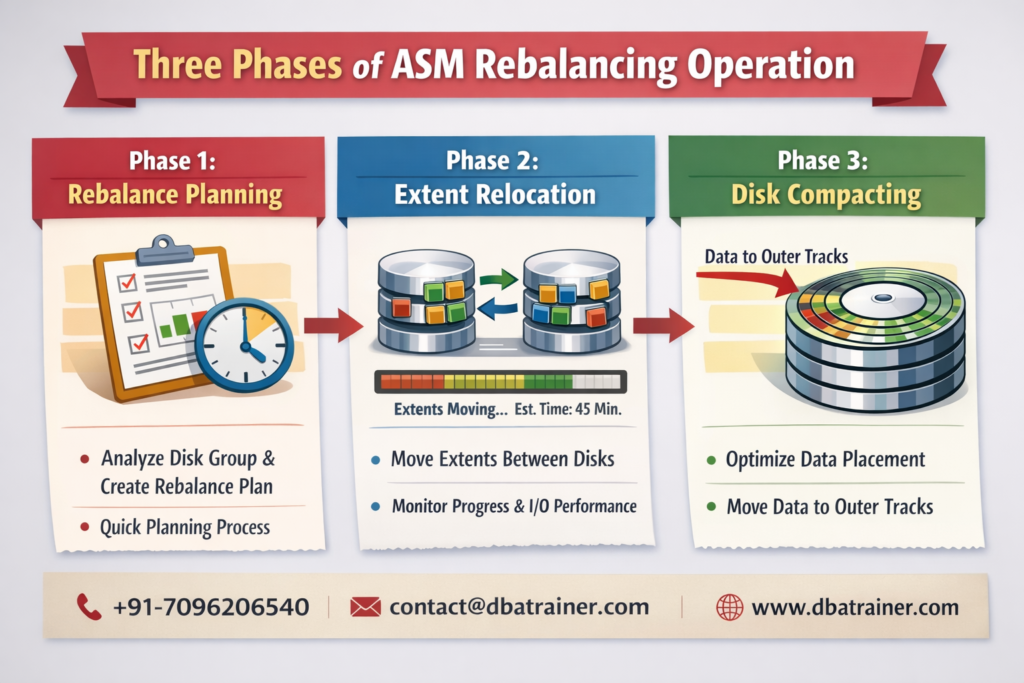
Three Phases of Oracle ASM Rebalancing Operation

Learn the three phases of Oracle ASM rebalancing – planning, extent relocation, and disk compacting. Understand how ASM redistributes data efficiently with minimal downtime. Introduction Oracle Automatic Storage Management (ASM) provides high availability and optimal I/O performance by automatically managing disk storage. Whenever disks are added, dropped, or resized, ASM triggers a rebalance operation to evenly distribute data across the disk group. ASM rebalance is internally executed in three well-defined phases, ensuring efficiency and performance stability. Phase 1: Rebalance Planning In this initial phase, ASM analyzes the disk group and prepares a rebalance strategy. Key activities include: Identifying the rebalance trigger (ADD / DROP / RESIZE disk) Analyzing disk group size and number of files Determining which extents need redistribution This phase is lightweight and usually completes within a few minutes. Phase 2 : Extent Relocation This is the most time-consuming phase of the ASM rebalance process. What happens here: ASM moves data extents between disks to achieve uniform distribution I/O load is dynamically managed based on system performance Progress is continuously tracked DBAs can monitor the estimated completion time using: SELECT * FROM GV$ASM_OPERATION; This view provides EST_MINUTES, which is calculated dynamically based on I/O throughput and extent movement speed. Phase 3 : Disk Compacting Introduced in Oracle ASM 11.1.0.7 and later, this phase optimizes data placement. Purpose of disk compacting: Moves data closer to the outer tracks of disks Improves I/O performance Optimizes disk layout after rebalance completion This phase fine-tunes the disk group for long-term performance benefits. Conclusion The three-phase ASM rebalance mechanism ensures: Efficient data redistribution Minimal impact on database availability Optimized disk performance Understanding these phases helps DBAs plan maintenance activities and monitor rebalance operations effectively.

Three Phases of Oracle ASM Rebalancing Operation Read More »
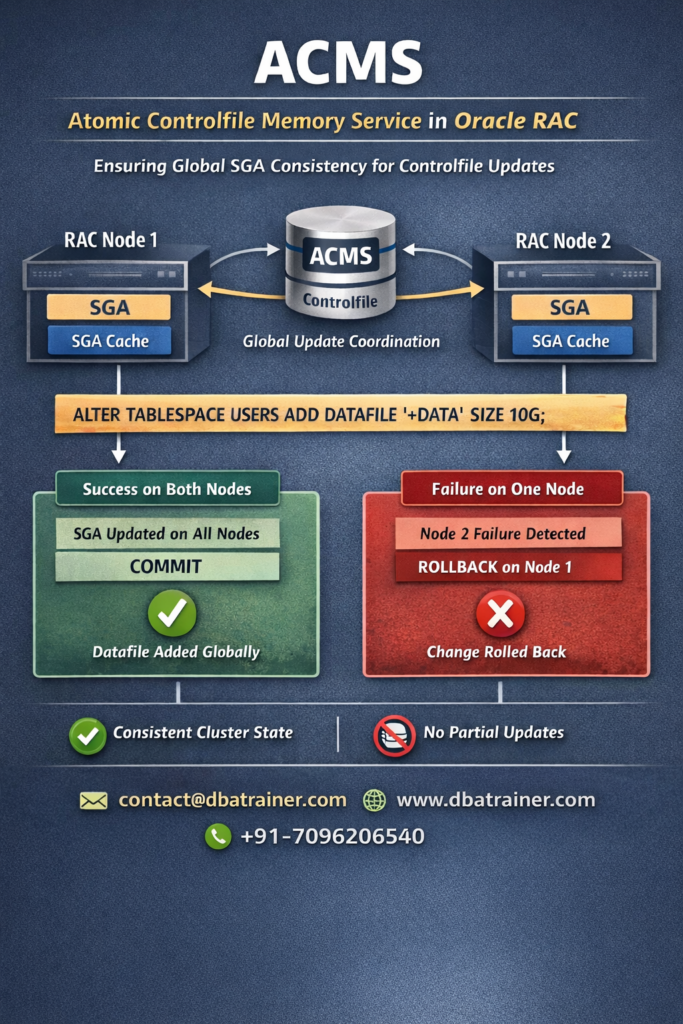
ACMS – Atomic Controlfile to Memory Service

What ACMS is :- ACMS (Atomic Controlfile Memory Service) is an Oracle RAC background agent that ensures atomic and consistent updates of control-file–related metadata cached in the SGA across all RAC instances. In simple terms:When a control-file–related memory update occurs in RAC, ACMS guarantees that the update is either committed successfully on all instances or rolled back on all instances – never partially applied. This ensures cluster-wide consistency. Why ACMS Is Required in RAC :- In an Oracle RAC environment: If one instance updates its SGA and another instance fails mid-operation: ACMS prevents this by enforcing atomicity. What ACMS Protects :- ACMS ensures atomic updates for: Practical Example :- Scenario: Adding a Datafile in RAC Executed on RAC1: ALTER TABLESPACE users ADD DATAFILE ‘+DATA’ SIZE 10G; Internal Processing: Case 1: Successful Update ✅ Datafile visible on all instances✅ Cluster remains consistent Case 2: Failure on One Instance ❌ No partial update❌ No corruption✅ Cluster-wide consistency preserved What If ACMS Did Not Exist? Without ACMS: 👉 ACMS prevents this exact failure scenario. Relationship with Other RAC Services One-Line Answer 💡 ACMS ensures atomic, cluster-wide consistency of control-file–related SGA updates in Oracle RAC by committing changes globally or rolling them back on failure.  

ACMS – Atomic Controlfile to Memory Service Read More »

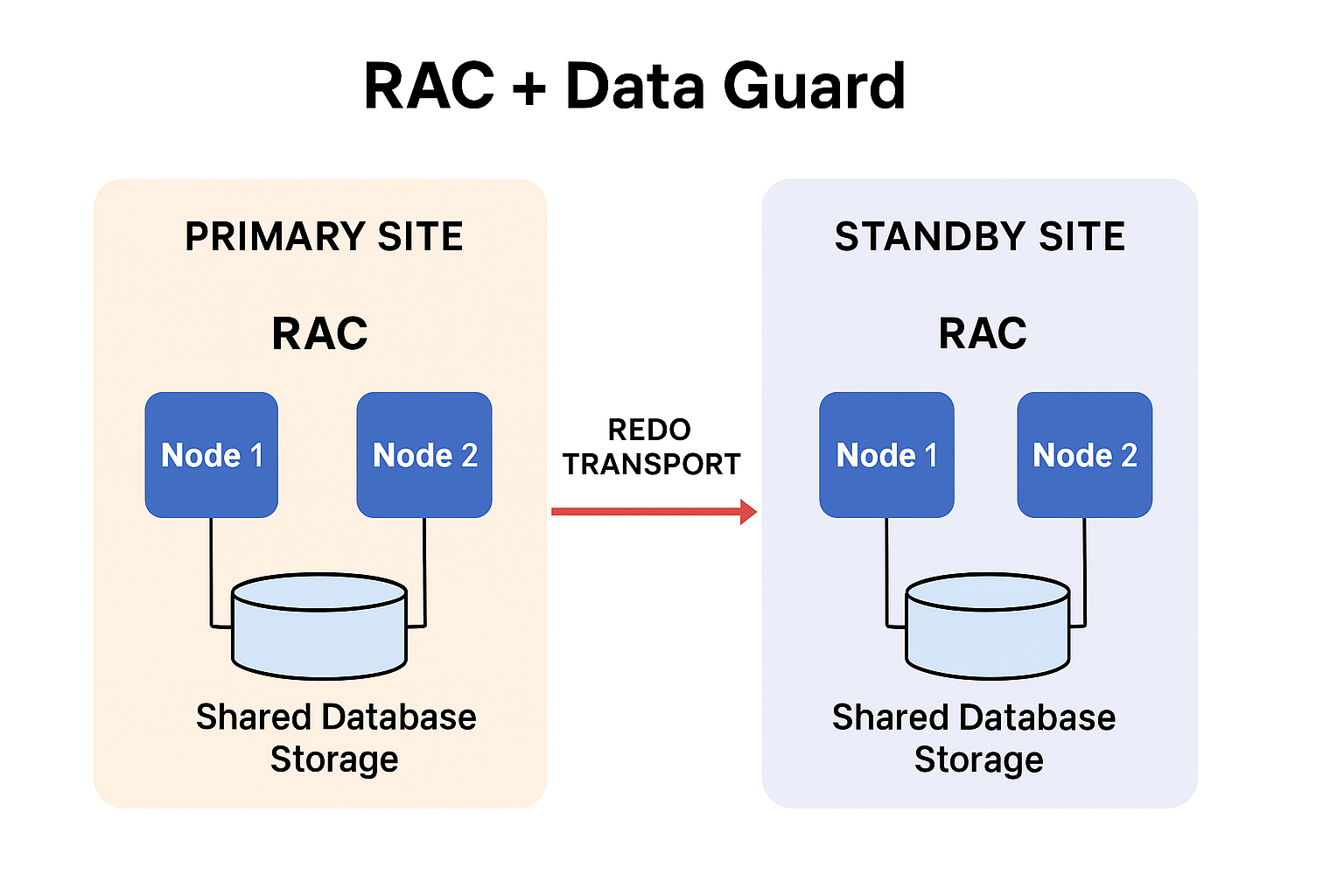
Oracle RAC + Data Guard – The Perfect Architecture for Mission Critical Databases

Oracle RAC in the Primary – Availability, Scalability & Load Sharing Oracle RAC in the primary site delivers three major advantages: High Availability (HA) If one database server/node fails, another node continues serving users. Database stays online Sessions re-route to surviving nodes No outage for applications Planned maintenance can be done node-by-node Result: Continuous availability for the primary database Scalability Multiple nodes work together as a single database. Add more nodes when user load increases Increase throughput without downtime Ideal for large OLTP workloads Result: System capacity grows as business demands grow Load Balancing User connections automatically spread across multiple RAC nodes. No single-node overload Balanced CPU & memory usage Better response time during peak hours Result: Efficient resource utilization and stable performance Data Guard Standby RAC – Disaster Recovery & Workload Offloading Data Guard with RAC on the standby site provides powerful advantages: Disaster Recovery (DR) If the entire primary site fails: Standby RAC becomes the new primary Minimal downtime (seconds to minutes) Minimal or zero data loss (SYNC/ASYNC mode) Result: Business continues even if the main site is lost Offloading Workloads (Active Data Guard) The standby RAC database can run real workloads, not just sit idle. You can offload: Reporting BI queries Long read-only operations Backup jobs ETL extractions Result: Primary RAC focuses on OLTP while standby handles heavy reads This significantly improves performance and reduces resource pressure on the primary site. Combined Outcome – What RAC + Data Guard Deliver Together Using both gives unmatched resilience: Near-zero downtime Node failure → RAC handles it Site failure → Data Guard handles it. Predictable performance Workload spread across nodes Scalable growth Add RAC nodes or standby nodes anytime Better resource utilization Move reporting & heavy reads to standby End-to-end resilience Highly available primary + disaster-protected secondary So Here  , Oracle RAC and Data Guard together provide an enterprise-class foundation that eliminates single points of failure, keeps systems responsive under growing workloads, and protects data against site-level failures. RAC handles node-level resilience and performance, while Data Guard ensures site-level continuity and operational efficiency through offloading. When implemented correctly, this architecture delivers unmatched uptime, flexibility, and operational confidence.

Oracle RAC + Data Guard – The Perfect Architecture for Mission Critical Databases Read More »