
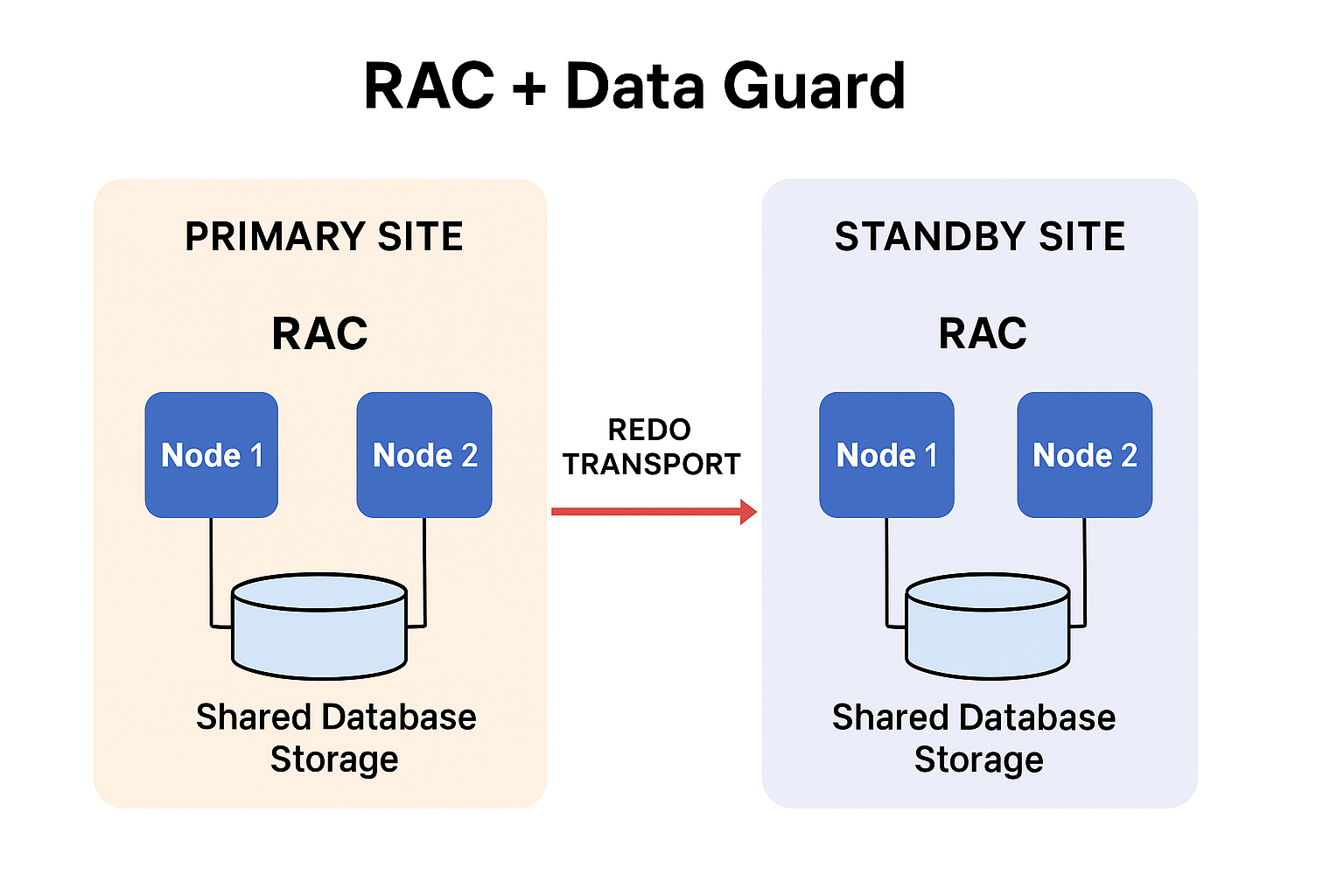
Oracle RAC in the Primary – Availability, Scalability & Load Sharing
Oracle RAC in the primary site delivers three major advantages:
 High Availability (HA)
If one database server/node fails, another node continues serving users.
-
- Database stays online
-
- Sessions re-route to surviving nodes
-
- No outage for applications
-
- Planned maintenance can be done node-by-node
Result: Continuous availability for the primary database
Scalability
Multiple nodes work together as a single database.
-
- Add more nodes when user load increases
-
- Increase throughput without downtime
-
- Ideal for large OLTP workloads
Result: System capacity grows as business demands grow
Load Balancing
User connections automatically spread across multiple RAC nodes.
-
- No single-node overload
-
- Balanced CPU & memory usage
-
- Better response time during peak hours
Result: Efficient resource utilization and stable performance
Data Guard Standby RAC – Disaster Recovery & Workload Offloading
Data Guard with RAC on the standby site provides powerful advantages:
Disaster Recovery (DR)
If the entire primary site fails:
-
- Standby RAC becomes the new primary
-
- Minimal downtime (seconds to minutes)
-
- Minimal or zero data loss (SYNC/ASYNC mode)
Result: Business continues even if the main site is lost
Offloading Workloads (Active Data Guard)
The standby RAC database can run real workloads, not just sit idle.
You can offload:
-
- Reporting
-
- BI queries
-
- Long read-only operations
-
- Backup jobs
-
- ETL extractions
Result: Primary RAC focuses on OLTP while standby handles heavy reads
This significantly improves performance and reduces resource pressure on the primary site.
Combined Outcome – What RAC + Data Guard Deliver Together
Using both gives unmatched resilience:
Near-zero downtime
- Node failure → RAC handles it
- Site failure → Data Guard handles it.
Predictable performance
- Workload spread across nodes
Scalable growth
- Add RAC nodes or standby nodes anytime
Better resource utilization
- Move reporting & heavy reads to standby
End-to-end resilience
- Highly available primary + disaster-protected secondary
So Here , Oracle RAC and Data Guard together provide an enterprise-class foundation that eliminates single points of failure, keeps systems responsive under growing workloads, and protects data against site-level failures. RAC handles node-level resilience and performance, while Data Guard ensures site-level continuity and operational efficiency through offloading. When implemented correctly, this architecture delivers unmatched uptime, flexibility, and operational confidence.